
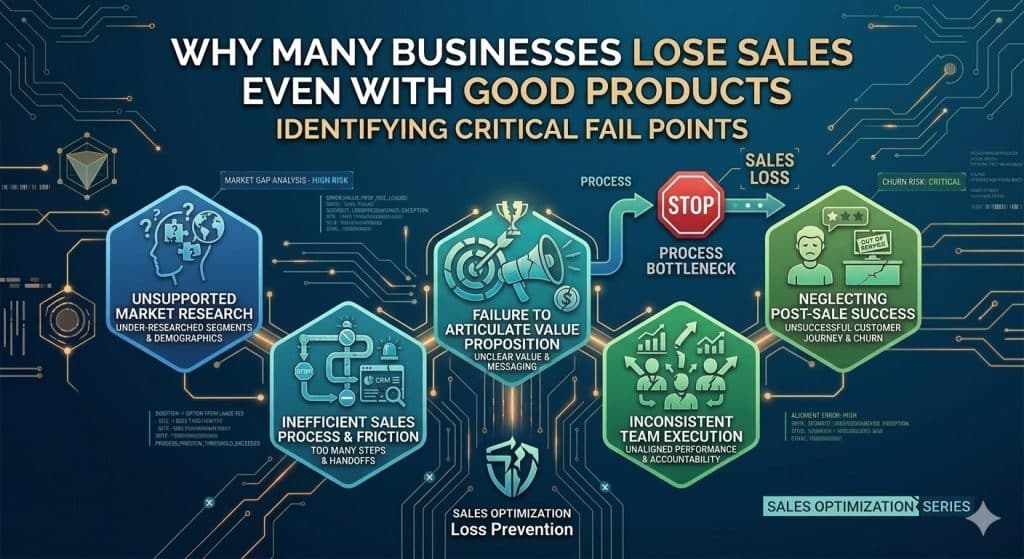
Most business owners, at some point, have thought: ‘We have a great product. So why are we not getting more sales?’
This is one of the most common and frustrating situations for small and medium business owners across India. You have invested time and money building something genuinely useful. You know the value it delivers. But when it comes to converting prospects into paying customers, the results are inconsistent at best.
Here is the uncomfortable truth: in most cases, the product is not the problem.
The real issue is the sales system — or the lack of one. Businesses often fail to close sales not because what they are selling is poor, but because of how they are selling it.
Understanding why businesses lose sales is the first step toward fixing the problem. In this article, we break down the key sales mistakes businesses make and what you can do to address them practically.
Why Good Products Alone Do Not Guarantee Sales
It is tempting to believe that a good product sells itself. In reality, purchasing decisions are driven by far more than the product’s features or quality.
Customers buy when three things align:
- They feel understood — the seller has demonstrated awareness of their specific problem.
- They trust the seller — there is confidence that the business can actually deliver on its promise.
- They see clear value — the benefit is communicated in a way that connects to their situation.
When any of these three elements is missing, even the best product will struggle to convert. A business might have the most innovative software in its category, but if the sales team cannot clearly explain how it solves the customer’s pain point, the prospect will hesitate or walk away.
This is particularly relevant in the Indian market, where relationship-based buying is common, trust plays a significant role in decisions, and customers often need multiple touchpoints before committing. Sales strategies for Indian businesses must account for these realities — not just rely on the product doing the work.
The 7 Key Reasons Why Businesses Lose Sales
Let us look at the most common and costly reasons why businesses fail to close sales — even when they have a strong product offering.
| Reason 1: Poor Understanding of Customer NeedsMany salespeople jump straight into product pitches without first understanding what the customer actually needs. When the conversation is product-centric rather than customer-centric, the prospect feels like they are being sold to rather than helped. This creates resistance, not connection.Example: A B2B software company in Pune kept pitching features like reporting dashboards and integrations. But the client’s actual pain point was onboarding delays. Once the salesperson shifted focus to how the software reduced onboarding time, the conversation — and the conversion rate — changed significantly. |
| Reason 2: Weak Sales ConversationsA sales conversation is not just a product explanation. It is a dialogue that builds rapport, uncovers needs, handles concerns, and guides the prospect toward a decision. Many businesses struggle here because their teams have never been trained on how to structure an effective sales conversation — from the opening to the close.Example: A financial services firm in Mumbai noticed that their sales calls had very little back-and-forth. Their team would talk for 20 minutes and then ask for a decision. Training the team to ask more questions and listen actively improved their conversion rate within weeks. |
| Reason 3: Lack of a Structured Sales ProcessWithout a clear sales process, every salesperson handles prospects differently. There is no consistency in how leads are qualified, how conversations are structured, or how follow-ups are handled. This leads to missed opportunities and unpredictable revenue — one of the most common sales mistakes businesses make.Example: A recruitment consultancy in Delhi had three sales executives who each ran the process their own way. One closed consistently; the other two struggled. When they mapped out and standardised the process based on what the top performer was doing, overall team performance improved. |
| Reason 4: Poor Follow-Up SystemsResearch consistently shows that the majority of sales happen after multiple follow-ups — yet most sales teams give up far too early. Without a structured follow-up system backed by a CRM tool, leads go cold, opportunities are forgotten, and revenue is left on the table.Example: A manufacturing business in Ahmedabad was generating a strong volume of inbound enquiries. But their follow-up was inconsistent — some leads got called once, others twice, with no fixed schedule. Implementing a simple CRM-based follow-up sequence recovered a significant number of stalled deals within the first month. |
| Reason 5: Weak Objection HandlingObjections are a natural part of any sales conversation — they are not rejections. However, many salespeople either become defensive when objections arise or fail to address them effectively. Without proper training in objection handling, businesses routinely lose sales that could have been won.Example: A digital marketing agency in Bengaluru frequently heard: ‘We tried digital marketing before and it did not work.’ Their team had no prepared, confident response to this objection. Once they developed a structured way to address it — acknowledging the concern, asking what had been tried, and reframing the conversation — they stopped losing prospects at that stage. |
| Reason 6: Pricing Communication MistakesPrice is rarely the real reason a prospect does not buy. More often, the issue is that the value has not been communicated clearly enough before the price is mentioned. When businesses lead with price — or fail to justify it in terms of customer outcomes — price becomes the focus of the conversation instead of the value.Example: A HR consulting firm in Hyderabad was frequently told their fees were too high. On closer review, their proposals listed services and rates but did not quantify the ROI or business impact. Restructuring their proposals to lead with outcomes and cost savings shifted the conversation entirely. |
| Reason 7: Inconsistent Sales Team PerformanceWhen a business’s revenue depends on one or two strong performers — or on the founder personally — it becomes difficult to scale and vulnerable to disruption. Inconsistent team performance is usually a symptom of missing training, unclear processes, and lack of coaching and accountability.Example: A logistics company in Chennai had one excellent salesperson and three average ones. The founder spent most of his time compensating for the weaker performers. Investing in structured training and a performance tracking system raised the team average and freed the founder to focus on business development. |
The Hidden Cost of Lost Sales Opportunities
Most business owners focus on the deals they won. But the greater impact often lies in the deals they lost without realising why.
Revenue Impact
Every unqualified lead that goes cold, every follow-up that never happened, and every objection that went unaddressed represents revenue that could have been captured. For most SMEs, improving conversion rates — even modestly — can add significant revenue without spending more on marketing.
Team Productivity
When salespeople work without a clear process or proper training, they spend enormous energy in the wrong places — chasing the wrong leads, repeating the same mistakes, and losing confidence after repeated rejections. This affects morale and productivity across the team.
Business Growth
The compounding effect of consistently losing sales is that the business struggles to grow, even when the market opportunity is strong. The founder typically steps in to compensate, which creates a bottleneck and prevents the business from scaling. Addressing the root causes of why customers don’t buy is essential for any business that wants to grow beyond this stage.
How Businesses Can Fix These Sales Problems
The good news is that most of these sales challenges are fixable — and they do not require expensive technology or a complete overhaul of your team. Here are the practical steps to get started:
Build a Structured Sales Process
Document your sales stages, define what happens at each step, and ensure every team member follows the same process. This creates consistency and makes performance measurable.
Improve Discovery Conversations
Train your team to ask better questions before they present solutions. Understanding the prospect’s situation, challenges, goals, and decision-making process is far more valuable than a polished product pitch.
Implement a Follow-Up System
Set up a CRM tool and build a structured follow-up sequence. Define how many touchpoints are made, through which channels, and at what intervals. This alone can recover a significant number of stalled deals.
Train on Objection Handling
Identify the top five objections your team regularly encounters and develop clear, confident responses for each. Role-play these situations regularly so the team handles them naturally in real conversations.
Track Sales Performance Metrics
Measure the right numbers — conversion rates at each stage of the funnel, number of follow-ups per deal, average deal size, and lead-to-close time. These metrics reveal where the bottlenecks are and what needs to be improved first.
How Sales Training Helps Businesses Improve Conversions
Understanding the problems is one thing. Fixing them in a sustained, scalable way requires structured sales training.
Sales training for small businesses helps teams in several specific ways. It gives salespeople a common language and framework, so everyone on the team is aligned. It builds confidence through practice — real role plays, recorded call reviews, and scenario-based learning that prepares the team for actual conversations. It also creates accountability, because trained teams know what good performance looks like and can be measured against clear standards.
Crucially, proper sales training does not just address skills — it addresses the sales system as a whole. It looks at the process, the tools, the follow-up structure, and the performance management approach. This is how businesses move from inconsistent, founder-dependent sales to a repeatable, team-driven revenue model.
For Indian SMEs specifically, improving sales performance means training that is grounded in the reality of local customer behaviour — including how to build trust with buyers who rely on relationships, how to handle price sensitivity without discounting, and how to navigate longer B2B sales cycles effectively.
How Transcend Biz Mentors Helps Businesses Improve Sales Performance
At Transcend Biz Mentors, we work with small and medium businesses across India to address the root causes of poor sales performance — not just the surface symptoms.
Developing Structured Sales Systems
We work with business owners to design a documented, practical sales process that fits their specific business model, customer profile, and market context. This creates the consistency and predictability that most SMEs are missing.
Training Sales Teams
Our sales training programs are built for real business environments. We focus on practical skills — discovery conversations, objection handling, closing techniques, and CRM usage — and we tailor the training to the specific challenges your team faces.
Improving Sales Conversations
Through live coaching, role plays, and call reviews, we help sales teams at every level improve how they communicate value, handle objections, and guide prospects toward confident decisions.
Building Scalable Revenue Systems
Our ultimate goal is to help business owners step back from personally driving every sale. We do this by developing the team’s capability, building accountability structures, and creating the systems and metrics needed to manage performance without the founder’s constant involvement.
If your business has a good product but is struggling to convert consistently, the answer is usually not a better product. It is a stronger sales system — and Transcend Biz Mentors can help you build one.
Conclusion
Having a good product is an important starting point. But in today’s competitive market — whether you are selling B2B services in Delhi, consumer products in Mumbai, or technology solutions in Bengaluru — a good product alone is rarely enough.
The businesses that grow consistently are those that invest as much in how they sell as in what they sell. They build structured sales processes. They train their teams continuously. They follow up systematically. They handle objections with confidence. And they track performance so they can improve over time.
If your business is losing sales despite having a strong offering, the path forward is clear: identify the gaps in your sales system, fix them methodically, and give your team the skills and tools they need to convert more of the leads you are already generating.
That is how good products become great businesses.
Is Your Sales System Holding Your Business Back?
| Work with Transcend Biz MentorsIf your business has a good product but is struggling to convert leads into customers consistently, the issue is almost always in the sales system — not the product. Transcend Biz Mentors works with Indian SMEs to build structured sales processes, train teams on proven frameworks, and create the accountability systems needed for consistent, scalable revenue. Explore our Sales Training and Business Mentoring Programs and start building a sales system that works as hard as your product does. Visit: www.transcendbizmentors.com | Contact us for a free consultation. |
Frequently Asked Questions (FAQs)
Q1. Why do businesses with good products still fail to close sales?
Most businesses lose sales not because of the product, but because of weak sales systems. Common issues include poor discovery conversations, lack of structured follow-up, ineffective objection handling, and inconsistent sales processes. Fixing these systemic gaps — rather than improving the product — is what typically leads to better conversion rates.
Q2. What are the most common sales mistakes small businesses make?
The most common sales mistakes include pitching too early without understanding customer needs, failing to follow up consistently, not having a structured sales process, poor handling of pricing conversations, and over-dependence on the founder to close deals. Each of these is fixable with the right training and systems.
Q3. How can I improve sales performance in my small business?
Start by documenting your sales process so every team member follows a consistent approach. Then invest in training your team on discovery conversations, objection handling, and closing. Implement a CRM tool for follow-up tracking and measure key metrics like conversion rates and pipeline health regularly. These steps alone can meaningfully improve performance within a few months.
Q4. Why do customers not buy even after showing interest?
Prospects who show interest but do not convert are usually missing one of three things: a clear understanding of how the solution solves their specific problem, enough trust in the seller’s ability to deliver, or sufficient urgency to act now. Addressing these through better discovery, stronger follow-up, and effective objection handling typically resolves this conversion gap.
Q5. How is sales training different from general business training?
Sales training focuses specifically on the skills, frameworks, and systems needed to convert prospects into customers. This includes practical areas like sales conversation structure, objection handling, lead qualification, CRM usage, and closing techniques. Unlike general business training, sales training is measured directly by improvements in conversion rates, deal sizes, and revenue — making it one of the most ROI-positive investments an SME can make.