
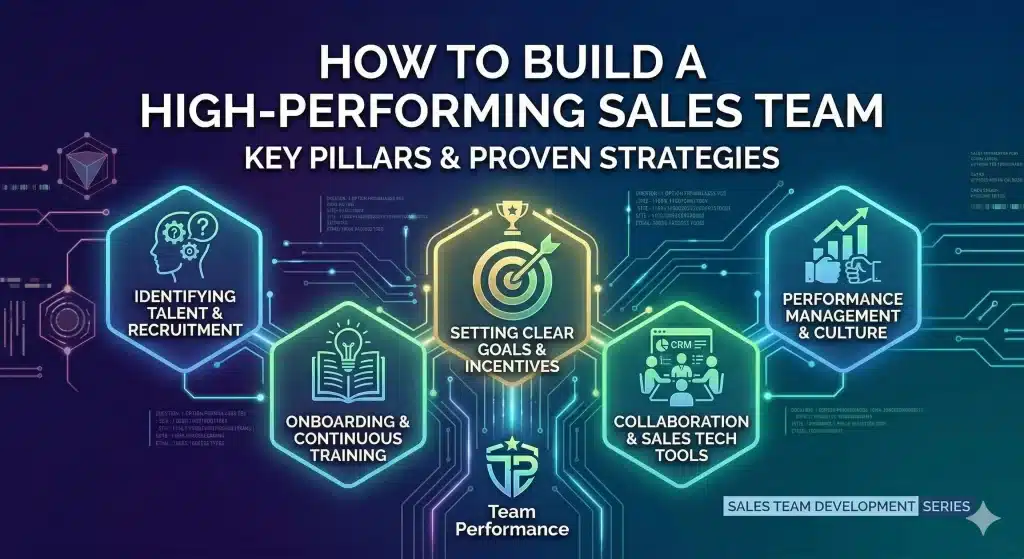
You have a sales team in place. You’re spending on leads. But at the end of the month, the revenue numbers still feel unpredictable.
If this sounds familiar, you are not alone. Many small and medium business owners across India face the same challenge. The problem is rarely a shortage of leads or even a lack of effort from the team. More often, the root cause is the absence of structured sales team training.
Why Your Sales Team Isn’t Delivering Consistent Result
Without a clear, repeatable sales process, your team members rely on guesswork. Every salesperson handles calls differently. Follow-ups are inconsistent. Objections go unanswered. And too often, the founder ends up closing the deals personally — which is not a scalable way to run a business.
This guide will walk you through what makes a high-performing sales team, what commonly goes wrong, and how a structured sales training program can transform your team’s performance and your business’s revenue trajectory.
What Makes a High-Performing Sales Team?
Not all sales teams are created equal. The best sales teams share a set of specific characteristics that allow them to consistently convert leads into customers — regardless of who is making the call.
Here is what separates a high-performing sales team from an average one:
A Clear and Documented Sales Process
High-performing teams follow a structured sales process — from the first point of contact to closing the deal. This process is documented, shared with the team, and followed consistently. There is no ambiguity about what needs to happen at each stage.
Strong Communication and Listening Skills
Great salespeople know how to ask the right questions, listen actively, and communicate value clearly. They understand that selling is not about talking more — it is about understanding the customer’s problem and presenting the right solution.
Consistent and Timely Follow-Up
Studies consistently show that most deals are closed after multiple follow-ups, yet many salespeople give up after one or two attempts. High-performing teams have a systematic follow-up process in place, backed by CRM tools, so no lead is ever forgotten.
Deep Understanding of Customer Needs
The best sales teams understand their customers — their business challenges, their decision-making process, and what they value most. This understanding allows them to position their product or service as the obvious solution rather than just another option.
Effective Objection Handling
Objections are a natural part of any sales conversation. Trained sales teams know how to handle common objections confidently, without becoming defensive or losing control of the conversation.
Explore Our Social Media Optimization Services
Common Problems in Sales Teams
Before you can fix your sales team’s performance, it helps to identify where things are breaking down. Here are the most common challenges we see in Indian SMEs:
• Lack of structured training: Most sales hires are given a brief product briefing and then left to figure things out on their own. Without proper onboarding and ongoing training, performance is inconsistent.
• Inconsistent sales approach: Different team members use different sales pitches, different ways of handling objections, and different closing techniques. This leads to unpredictable results.
• Poor lead qualification: Teams spend valuable time chasing leads that are not a good fit, while genuinely interested prospects are neglected. Without a clear qualification framework, this will continue.
• Weak follow-up systems: Follow-ups happen randomly, if at all. There is no CRM system, no structured follow-up schedule, and no accountability for whether leads are being nurtured effectively.
• Over-dependence on the founder for closing: When the team cannot close deals independently, the founder becomes a bottleneck. This limits business growth and prevents the company from scaling.
Recognising these problems in your own business is the first step. The next step is addressing them through a proper sales training program.
Why Sales Team Training Is Essential for Business Growth
Many business owners view sales training as an expense. In reality, it is one of the highest-ROI investments a business can make. Here is why:
Higher Conversion Rates
A trained sales team converts a higher percentage of leads into paying customers. Even a modest improvement in conversion rates — say from 10% to 15% — can significantly increase your monthly revenue without spending more on lead generation.
Greater Team Confidence
Salespeople who are properly trained feel more confident in their conversations. They know what to say, how to handle difficult questions, and how to guide a prospect toward a decision. This confidence comes through in every interaction.
Better Customer Communication
Sales training for teams goes beyond scripts and pitches. It helps your team develop empathy, understand customer psychology, and communicate more effectively — leading to better customer experience and higher retention.
Predictable and Scalable Revenue
When your team follows a structured sales process and uses a CRM system effectively, your revenue becomes more predictable. You can forecast monthly sales, identify bottlenecks, and make data-driven decisions to grow.
Explore Best Business Consultant Services in India
Key Elements of Effective Sales Team Training
An effective sales training program is not a one-day workshop or a motivational seminar. It is a structured, ongoing system that covers several key areas:
Building a Structured Sales Process
The foundation of any sales training program is a well-defined sales process. This includes defining your sales stages, setting clear goals for each stage, and creating a repeatable framework that the entire team follows.
Training in Sales Conversations
How your team opens a call, builds rapport, uncovers needs, presents solutions, and moves toward a close — all of this needs to be trained systematically. Role-play exercises, real call reviews, and scenario-based training are all effective methods.
Objection Handling Techniques
Your team needs a practical toolkit for handling the most common objections they encounter — whether it is about price, timing, decision authority, or trust. Training should cover both the language of objection handling and the mindset required to do it effectively.
CRM and Follow-Up Systems
Technology plays a critical role in modern sales teams. Training your team on CRM tools, setting up automated follow-up sequences, and building accountability into the system ensures that no opportunity slips through the cracks.
Sales Performance Tracking
What gets measured gets improved. Effective sales training teaches managers how to track key metrics — call volumes, conversion rates, deal sizes, pipeline health — and use this data to coach and improve performance continuously.
Read More:
Practical Steps to Build a High-Performing Sales Team
Here are actionable steps you can start implementing in your business right away:
• Step 1 – Document your sales process: Map out every step from lead to close. Make it simple, practical, and team-facing.
• Step 2 – Define your Ideal Customer Profile (ICP): Train your team on who is a good fit and who is not. This improves lead qualification immediately.
• Step 3 – Create a sales conversation framework: Give your team a proven script structure they can adapt to different customer conversations.
• Step 4 – Implement a CRM tool: Even a basic CRM helps your team track leads, schedule follow-ups, and manage their pipeline effectively.
• Step 5 – Hold regular sales reviews: Weekly team reviews to discuss pipeline health, challenges, and wins build accountability and continuous improvement.
• Step 6 – Invest in ongoing training: Sales training is not a one-time event. Schedule regular skill-building sessions, especially around objection handling and closing.
• Step 7 – Reduce founder dependency: Gradually transfer the closing responsibility to your team by training them, giving them more ownership, and building their confidence.
How Transcend Biz Mentors Sales Training Helps Businesses Build High-Performing Sales Teams
At Transcend Biz Mentors, we work specifically with Indian SMEs to build sales systems that actually work in the Indian market context — across industries, cities, and customer segments.
Here is how we approach sales training for teams:
Building Structured Sales Systems
We help you build a customised, step-by-step sales process that fits your business model. This gives your team clarity on what to do at every stage of the sales cycle, from the first conversation to the final close.
Training on Proven Sales Frameworks
Our sales training programs teach frameworks that are practical and adapted for Indian customer behaviour — including how to build trust quickly, how to handle price-sensitive buyers, and how to navigate multi-stakeholder decisions common in B2B sales.
Improving Sales Conversations and Closing Skills
Through real-world role plays, recorded call reviews, and personalised coaching, we help your team significantly improve their ability to lead effective sales conversations and close deals confidently — without being pushy.
Developing Sales Leadership and Accountability
We also work with your sales managers and team leads to build the skills needed to coach, track, and motivate their teams. Strong sales leadership is what sustains team performance long after the training is over.
Creating Scalable and Predictable Revenue Systems
Our goal is to help you move away from founder-dependent sales toward a team-driven revenue engine. We set up CRM workflows, follow-up systems, and performance dashboards so that your sales operation runs predictably and scales with your business.
If you are looking to improve sales team performance and build a system that generates consistent results, Transcend Biz Mentors offers a structured path to get there.
Real Business Impact of Structured Sales Training
When businesses invest in proper sales team training, the results go beyond just increased revenue. Here is what typically changes:
Higher Conversions Without More Spending on Leads
A trained team converts more from the existing lead flow. Business owners often find that they do not need to generate more leads — they simply need to convert the ones they already have more effectively.
Improved Team Productivity
When salespeople have a clear process, proper tools, and the right skills, they work more efficiently. Less time is wasted on unqualified leads or repetitive tasks, and more energy goes into productive selling activities.
Reduced Founder Dependency
One of the most significant shifts business owners report is being able to step back from day-to-day sales. When the team has the skills and the system, the founder can focus on growth strategy rather than individual deal closures.
Scalable Growth
With a structured sales process and a trained team, scaling becomes easier. Onboarding new sales hires is faster, performance is more consistent, and the business can grow revenue without the founder being the single point of failure.
Explore Mentorship Services in India
Conclusion: Sales Team Training Is a Business Investment, Not an Expense
Building a high-performing sales team does not happen by accident. It requires a clear sales process, consistent training, the right tools, and strong accountability systems.
For Indian SMEs looking to scale, the difference between a business that plateaus and one that grows consistently often comes down to this: how well trained and how well equipped is the sales team?
Structured sales team training gives your business a competitive edge. It improves conversion rates, builds team confidence, creates a better customer experience, and — most importantly — reduces your dependence on yourself for revenue.
Whether you are building your first sales team or trying to improve an existing one, the right sales training program can transform the way your business generates revenue.
Frequently Asked Questions (FAQs)
Q1. What is sales team training and why is it important for small businesses?
Sales team training is the process of developing your sales staff’s skills, knowledge, and systems to help them sell more effectively. For small businesses, it is important because it creates consistency, improves conversion rates, and reduces the owner’s dependence on personally closing every deal.
Q2. How do I know if my sales team needs training?
Common signs include inconsistent monthly revenue, low lead-to-customer conversion rates, your team struggling to handle objections, heavy dependence on you for closing, and poor follow-up on leads. If any of these apply, structured sales training is likely a high-ROI investment for your business.
Q3. What should a good sales training program cover?
A good sales training program should cover the full sales process — from lead qualification to closing — along with sales conversation frameworks, objection handling techniques, CRM and follow-up systems, and sales performance tracking. It should also include ongoing coaching and accountability.
Q4. How long does it take to see results from sales team training?
Many businesses start seeing improvements in sales conversations and follow-up consistency within the first four to six weeks of structured training. Measurable improvement in conversion rates and revenue typically follows within two to three months, depending on the team’s starting point and how consistently the training is applied.
Q5. Are sales training strategies different for the Indian market?
Yes. The Indian market has distinct characteristics — including price sensitivity, relationship-based buying, longer decision cycles in B2B, and diverse regional customer behaviours. Effective sales training for Indian SMEs addresses these realities and equips teams to navigate them confidently, rather than applying generic global sales methodologies without adaptation.